

Television screens have undergone remarkable transformations since their inception, with each technological leap bringing viewers closer to lifelike imagery. The shift from bulky cathode ray tubes to sleek flat panels revolutionised living rooms worldwide, but perhaps no advancement has been as significant as the recent transition to OLED technology. Manufacturers across the globe have embraced organic light-emitting diode panels, abandoning traditional LED-backlit displays in favour of this self-emissive technology. This strategic pivot represents more than mere incremental improvement; it signals a fundamental reimagining of what television displays can achieve in terms of picture quality, design flexibility, and viewer experience.
Adoption of OLED technology by television manufacturers
Industry leaders embrace organic displays
Major television manufacturers have progressively integrated OLED panels into their premium product lines, recognising the technology’s potential to redefine home entertainment. LG Electronics emerged as a pioneering force, investing heavily in OLED production facilities and research capabilities. The company’s commitment extended beyond mere adoption, as it developed proprietary manufacturing processes that would eventually supply panels to competitors. Panasonic similarly recognised OLED’s promise, incorporating these displays into flagship models aimed at discerning consumers seeking superior visual performance.
The adoption pattern reveals a calculated approach by manufacturers:
- Initial introduction through high-end models to establish premium positioning
- Gradual expansion across product ranges as manufacturing costs decreased
- Strategic partnerships with panel suppliers to secure consistent inventory
- Investment in consumer education campaigns highlighting OLED advantages
Market positioning and consumer response
Television makers positioned OLED displays as the pinnacle of viewing technology, justifying premium pricing through demonstrable performance advantages. Consumer reception proved overwhelmingly positive, with early adopters praising the visual improvements over conventional LED televisions. This enthusiastic response encouraged manufacturers to accelerate their OLED rollout strategies, expanding availability across different screen sizes and price points. The technology’s adoption created a clear market segmentation, with OLED models occupying the premium tier whilst LED televisions served budget-conscious consumers.
Understanding why manufacturers committed so decisively to OLED requires examining the technology’s origins and the expectations that surrounded its development.
The early days of OLED: an awaited revolution
Technological promise and initial challenges
Organic light-emitting diode technology represented a fundamentally different approach to display manufacturing, one that promised to overcome longstanding limitations of liquid crystal displays. Early research demonstrated OLED’s potential for perfect blacks, infinite contrast ratios, and vibrant colours, creating considerable excitement within the industry. However, the path from laboratory prototypes to commercial viability proved lengthy and fraught with technical obstacles. Issues including limited lifespan, susceptibility to moisture damage, and manufacturing complexity initially hindered widespread adoption.
The challenges facing early OLED development included:
- Image retention and burn-in concerns affecting panel longevity
- Manufacturing yield rates significantly lower than established LCD production
- High production costs limiting commercial viability
- Colour accuracy variations requiring extensive calibration
Breakthrough innovations enabling commercialisation
Persistent research and development efforts gradually resolved these technical barriers, making OLED televisions commercially feasible. Advances in organic materials chemistry extended panel lifespans dramatically, whilst improved encapsulation techniques protected sensitive components from environmental degradation. Manufacturing processes matured, increasing yield rates and reducing per-unit costs. These breakthroughs transformed OLED from an intriguing laboratory curiosity into a practical display technology capable of mass production.
These technical achievements set the stage for OLED to challenge the dominance of established display technologies that had served the industry for decades.
The evolution of TV technology: from LED to OLED
The LED television era
LED televisions, utilising liquid crystal displays illuminated by light-emitting diode backlights, dominated the market for years following their introduction. These displays offered significant improvements over earlier technologies, including reduced power consumption, slimmer profiles, and enhanced brightness levels. Manufacturers refined LED backlight implementations through local dimming zones, edge-lighting configurations, and full-array arrangements, each attempting to improve contrast performance and black levels.
| Technology Aspect | LED Television | OLED Television |
|---|---|---|
| Backlight requirement | Required | Self-emissive |
| Black level performance | Limited by backlight | Perfect blacks |
| Panel thickness | Moderate | Ultra-thin |
| Viewing angles | Restricted | Wide |
Transition drivers and industry momentum
The shift from LED to OLED gained momentum as consumer expectations evolved and content quality improved. Ultra-high-definition content proliferation demanded displays capable of rendering increased detail and dynamic range, characteristics where OLED excelled. Manufacturers recognised that incremental LED improvements could not match OLED’s inherent advantages, prompting strategic reorientation towards organic display technology. This transition paralleled broader industry trends towards premium positioning and differentiation through technological superiority.
The compelling reasons for this technological shift become clearer when examining the specific performance advantages OLED panels deliver over their LED predecessors.
The advantages of OLED panels over LED
Superior image quality characteristics
OLED technology’s self-emissive nature fundamentally transforms image reproduction, as each pixel generates its own light independently. This architecture enables complete pixel deactivation, producing absolute black levels impossible with backlit displays. The resulting contrast ratios effectively become infinite, as the ratio between the brightest whites and darkest blacks reaches unprecedented levels. This capability enhances detail visibility in both shadow areas and highlights, creating images with exceptional depth and dimensionality.
Key image quality advantages include:
- Perfect black levels through complete pixel shutdown
- Exceptional contrast ratios enhancing perceived image depth
- Accurate colour reproduction across the entire spectrum
- Minimal motion blur due to rapid pixel response times
- Consistent image quality across wide viewing angles
Design flexibility and energy efficiency
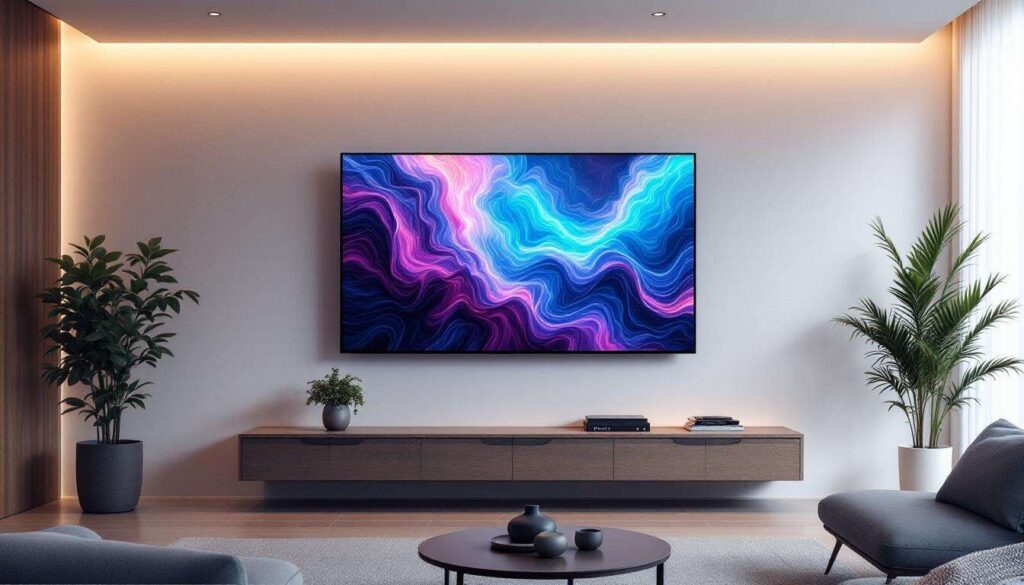
The absence of backlight assemblies allows OLED panels to achieve remarkable thinness, enabling television designs previously impossible with LED technology. Manufacturers capitalise on this flexibility by creating displays mere millimetres thick, some capable of mounting flush against walls like artwork. This design freedom extends to curved screens and potentially flexible displays, opening new possibilities for television form factors. Additionally, OLED panels demonstrate energy efficiency advantages, consuming less power than comparable LED televisions by illuminating only necessary pixels rather than maintaining constant backlighting.
Addressing previous limitations
Recent OLED generations have systematically addressed earlier concerns regarding durability and image retention. Advanced pixel-refreshing algorithms, improved organic materials, and sophisticated heat management systems significantly reduce burn-in risks. Innovations such as Tandem WOLED architecture employ stacked organic layers to enhance brightness capabilities and extend operational lifespans, making OLED technology increasingly robust for everyday use. These improvements have effectively eliminated the hesitation some consumers previously felt regarding OLED longevity.
These technical superiorities have translated into significant market impact, reshaping consumer preferences and industry dynamics.
The impact of OLED televisions on the market
Market segmentation and pricing dynamics
OLED televisions established a distinct premium segment within the display market, commanding higher prices justified by demonstrable performance advantages. This segmentation allowed manufacturers to maintain healthy profit margins whilst differentiating their offerings from budget-oriented LED models. Consumer willingness to invest in OLED technology validated manufacturer strategies, creating a sustainable premium tier that drove innovation and brand prestige. Price erosion occurred gradually as manufacturing efficiencies improved, making OLED accessible to broader consumer segments without completely eliminating the premium positioning.
Consumer awareness and purchasing behaviour
Growing consumer awareness of OLED advantages fundamentally altered television purchasing decisions, with informed buyers actively seeking organic display technology. Retail demonstrations showcasing side-by-side comparisons between LED and OLED displays proved particularly effective, as the visual differences were immediately apparent. This heightened awareness created market pressure on manufacturers to expand OLED availability across various screen sizes and price points, accelerating the technology’s market penetration.
These market dynamics continue evolving as manufacturers pursue the next generation of OLED innovations and explore emerging display technologies.
The future of OLED: innovations and trends
Emerging technological refinements
Ongoing research continues pushing OLED capabilities forward through architectural innovations and material science advances. Tandem WOLED technology represents a significant evolution, utilising multiple stacked organic layers to achieve higher peak brightness levels whilst maintaining energy efficiency and extending panel longevity. This approach addresses one of OLED’s few remaining performance gaps compared to high-brightness LED displays, particularly relevant for viewing in brightly lit environments. Manufacturers showcase these advancements at industry events, demonstrating progressively larger screens with enhanced specifications.
Scaling and accessibility trends
The OLED roadmap includes expansion across screen sizes, from compact displays to massive panels exceeding conventional dimensions. Manufacturing improvements enable larger OLED production whilst maintaining quality standards and managing costs. This scaling effort aims to make OLED technology accessible across broader market segments, eventually positioning it as the standard rather than premium option. Simultaneously, manufacturers explore new form factors including transparent displays, rollable screens, and modular configurations that leverage OLED’s inherent flexibility.
Future developments may include:
- Enhanced brightness capabilities rivalling LED peak performance
- Extended operational lifespans through improved materials
- Reduced manufacturing costs enabling mainstream pricing
- Novel form factors exploiting OLED flexibility
- Integration with emerging technologies such as microLED
The trajectory suggests OLED will continue dominating premium television segments whilst gradually expanding its market presence through technological refinement and cost reduction. Manufacturers remain committed to organic display technology, viewing it as the foundation for next-generation viewing experiences that will define home entertainment for years ahead.
Television manufacturers’ embrace of OLED technology reflects a calculated response to both technical possibilities and market demands. The transition from LED-backlit displays to self-emissive organic panels addresses fundamental limitations whilst delivering measurable improvements in image quality, design flexibility, and energy efficiency. Early technical challenges have been systematically overcome through persistent innovation, resulting in commercially viable products that justify premium positioning. Consumer response validates manufacturer strategies, creating sustainable market dynamics that encourage continued investment in OLED refinement. As the technology matures, expanding accessibility and ongoing innovations promise to cement OLED’s position as the preferred display technology for discerning viewers seeking the ultimate home entertainment experience.