



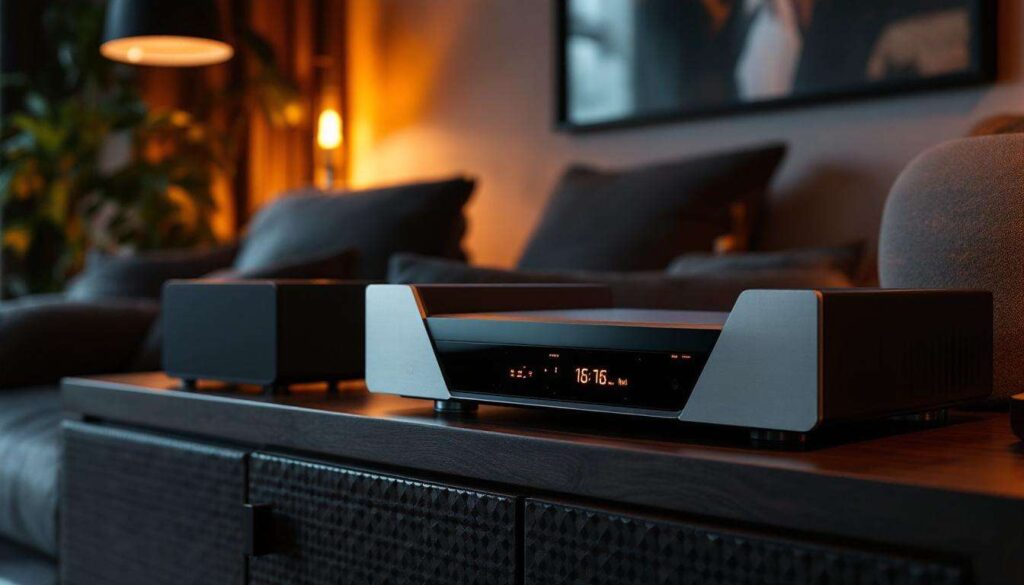
High-quality audio reproduction has become increasingly accessible to everyday consumers, thanks to technological advances that integrate multiple functions into single devices. Streaming amplifiers represent this evolution perfectly, merging traditional amplification with modern digital connectivity. Whether you’re seeking to breathe new life into existing passive speakers or building an entirely new system, selecting the right streaming amplifier can transform your listening experience whilst simplifying your setup considerably.
Streaming amplifier: what is currently available ?
The market for streaming amplifiers has expanded significantly, offering solutions that cater to various preferences and technical requirements. These sophisticated devices eliminate the need for separate components by integrating amplification, digital-to-analogue conversion, and network connectivity into a single chassis.
Core functionality explained
A streaming amplifier serves dual purposes: it powers passive speakers whilst simultaneously providing access to digital music sources. The built-in digital-to-analogue converter ensures that streaming content maintains exceptional fidelity, translating digital files into analogue signals that speakers can reproduce accurately.
Modern streaming amplifiers typically include:
- Wi-Fi and Ethernet connectivity for stable internet access
- Bluetooth capabilities for convenient device pairing
- Support for high-resolution audio formats including FLAC, ALAC, and DSD
- Compatibility with major streaming platforms such as Spotify, Tidal, Qobuz, and Deezer
- Multi-room audio integration through protocols like AirPlay 2, Chromecast, and proprietary systems
Market segmentation
Manufacturers have developed products across three distinct price brackets, each offering different feature sets and performance characteristics. Entry-level models typically range from £300 to £600, providing essential streaming functions with respectable sound quality. Mid-range options between £600 and £1,500 deliver enhanced audio performance, superior build quality, and expanded connectivity. Premium amplifiers exceeding £1,500 target audiophiles demanding reference-grade components and exceptional sonic transparency.
Understanding these categories helps narrow down choices based on both financial considerations and performance expectations, which naturally leads to examining the specific criteria that distinguish exceptional amplifiers from mediocre ones.
Criteria for selecting a high-performance amplifier
Identifying a truly capable streaming amplifier requires evaluating several technical and practical factors that directly impact long-term satisfaction and audio quality.
Power output and speaker compatibility
The amplifier’s power rating, measured in watts per channel, must match your speakers’ requirements. Insufficient power results in distortion at higher volumes, whilst excessive power rarely causes issues with modern speakers featuring built-in protection. Most bookshelf speakers perform optimally with 50-100 watts per channel, whereas floorstanding models may demand 100 watts or more.
Digital audio processing capabilities
The quality of the internal DAC significantly influences sound reproduction. Premium streaming amplifiers incorporate high-grade DAC chips capable of processing files up to 24-bit/192kHz or even DSD256. This specification matters particularly for listeners who maintain libraries of high-resolution downloads or subscribe to lossless streaming services.
| Audio format | Quality level | Typical use case |
|---|---|---|
| MP3/AAC 320kbps | Standard | Casual listening |
| CD quality (16-bit/44.1kHz) | High | Most streaming services |
| 24-bit/96kHz or higher | Audiophile | Critical listening, studio masters |
Connectivity and ecosystem integration
Comprehensive connectivity options ensure flexibility for current and future sources. Essential connections include:
- Multiple digital inputs (optical, coaxial, USB)
- Analogue inputs for turntables or legacy equipment
- Subwoofer output for expanding bass response
- Network streaming protocols supporting your preferred services
Compatibility with existing smart home ecosystems through AirPlay, Chromecast, or Spotify Connect enhances convenience significantly, allowing seamless control from smartphones and tablets.
With these evaluation criteria established, examining specific models within each price category reveals how manufacturers balance these factors against cost constraints.
Entry-level amplifiers: the best choices
Affordable streaming amplifiers have improved dramatically, offering impressive performance that satisfies most listeners without requiring substantial investment.
Yamaha R-N600A: versatile and reliable
This Japanese manufacturer’s offering combines traditional stereo receiver functionality with modern streaming capabilities. The R-N600A delivers 90 watts per channel, sufficient for medium-sized rooms and moderately efficient speakers. Its comprehensive app control simplifies navigation through streaming services, whilst the inclusion of both digital and analogue inputs accommodates diverse source components.
Key advantages include:
- MusicCast multi-room integration for whole-home audio
- High-resolution audio support up to 24-bit/192kHz
- Phono input for direct turntable connection
- Intuitive smartphone control application
Cambridge Audio MXN10: compact excellence
For those prioritising space efficiency without sacrificing quality, this British manufacturer offers a streaming preamp that requires separate power amplification. However, its exceptional DAC and comprehensive streaming platform support make it worthy of consideration when paired with suitable amplification. The compact form factor suits modern living spaces where traditional hi-fi equipment appears visually intrusive.
Value proposition analysis
Entry-level models sacrifice some refinement in component quality and construction compared to pricier alternatives, yet they provide genuine high-fidelity reproduction that vastly exceeds basic Bluetooth speakers or soundbars. These amplifiers represent ideal starting points for newcomers to quality audio whilst offering sufficient performance to satisfy experienced listeners on constrained budgets.
Stepping up to mid-range options delivers noticeable improvements in sonic refinement and build quality that justify the additional expenditure for discerning listeners.
Mid-range options: balancing quality and price
The middle market segment offers the most compelling value proposition, combining near-reference audio quality with reasonable pricing that remains accessible to enthusiasts.
NAD C 3050 LE: modern classic
This Canadian manufacturer’s integrated amplifier exemplifies intelligent engineering focused on sonic priorities. The C 3050 LE incorporates BluOS streaming platform, widely regarded as one of the most comprehensive and stable systems available. With 100 watts per channel using NAD’s Hybrid Digital amplification technology, it drives demanding speakers effortlessly whilst maintaining exceptional clarity across the frequency spectrum.
Notable features include:
- BluOS platform supporting over 20 streaming services
- Modular design allowing future upgrades
- High-current output suitable for complex speaker loads
- Comprehensive room correction capabilities through Dirac Live
Sonos Amp: ecosystem integration
Positioned uniquely within the streaming amplifier category, this model prioritises seamless multi-room functionality over absolute sonic refinement. The Sonos Amp delivers 125 watts per channel and integrates perfectly with existing Sonos wireless speakers, creating cohesive whole-home audio systems. Its automatic Trueplay tuning optimises performance for specific room acoustics, though this feature requires iOS devices.
Performance expectations
Mid-range streaming amplifiers employ superior components including better capacitors, more robust power supplies, and refined circuit layouts. These improvements manifest as tighter bass control, improved soundstage depth, and enhanced dynamic range. The difference becomes particularly apparent during complex musical passages where entry-level models can sound congested.
| Feature | Entry-level | Mid-range |
|---|---|---|
| Power output | 50-90W per channel | 100-150W per channel |
| DAC quality | Standard chipsets | Premium converters |
| Build quality | Plastic/basic metal | Aluminium/steel chassis |
| Upgrade potential | Limited | Modular options |
For listeners seeking ultimate performance and willing to invest substantially, premium amplifiers offer refinements that approach the limits of human hearing perception.
The pinnacle of luxury: premium amplifiers for audiophiles
High-end streaming amplifiers represent the convergence of reference-grade engineering and cutting-edge digital technology, delivering performance that satisfies even the most critical listeners.
Naim Uniti Atom Headphone Edition: specialist excellence
This British manufacturer’s offering targets headphone enthusiasts specifically, though it also drives speakers admirably. The custom-designed headphone amplification circuitry extracts maximum detail from high-impedance audiophile headphones, whilst the 40-watt speaker output suits nearfield monitoring or compact speakers. Its hand-assembled construction and premium components justify the substantial investment for those prioritising sonic purity above all else.
Linn Selekt DSM: modular sophistication
Scottish manufacturer Linn’s flagship streaming system offers unprecedented flexibility through its modular architecture. Buyers select power amplification modules matching their speakers’ requirements, whilst the digital source components remain consistent. This approach allows incremental upgrades as budgets permit or requirements evolve, protecting the initial investment whilst maintaining cutting-edge performance.
What premium pricing delivers
Beyond measurable specifications, luxury amplifiers provide intangible qualities including:
- Vanishingly low distortion across all frequencies
- Exceptional transient response revealing micro-details
- Superior power supply regulation maintaining consistency regardless of mains quality
- Exquisite industrial design using premium materials
- Extended manufacturer support and upgrade pathways
The sonic improvements become increasingly subtle as price rises, following the law of diminishing returns. However, for dedicated audiophiles, these refinements matter profoundly, justifying expenditure that might seem excessive to casual listeners.
Regardless of budget, selecting the appropriate amplifier requires careful consideration of personal circumstances and priorities beyond mere specifications.
Tips for choosing the right amplifier for your audio needs
Making an informed decision involves assessing multiple factors specific to your situation rather than simply purchasing the highest-rated or most expensive option.
Assess your existing equipment
Your speakers represent the most critical component in any audio system. Amplifier selection must prioritise compatibility with existing or planned speakers. Check sensitivity ratings and impedance specifications to ensure adequate power delivery. Highly efficient speakers exceeding 90dB sensitivity require less power, whilst planar magnetic or electrostatic designs demand substantial current delivery.
Consider your listening environment
Room size and acoustic properties significantly influence amplifier requirements. Larger spaces demand more power to achieve satisfying volume levels, whilst smaller rooms may benefit from amplifiers offering sophisticated room correction to compensate for acoustic deficiencies. Open-plan living areas present particular challenges requiring careful power matching.
Evaluate streaming service preferences
Verify that prospective amplifiers support your preferred music services natively. Whilst most platforms work across devices, native integration provides superior stability and functionality compared to casting or Bluetooth connections. Subscribers to high-resolution services should prioritise amplifiers capable of processing these formats without downsampling.
Future-proofing considerations
Technology evolves rapidly, making expandability valuable. Look for:
- Firmware update capability ensuring compatibility with emerging streaming protocols
- Modular designs allowing component upgrades
- Comprehensive connectivity supporting legacy and future sources
- Established manufacturer reputation for long-term support
Audition before purchasing
Specifications reveal capabilities but cannot convey subjective sonic character. Personal auditions using familiar music remain essential for identifying amplifiers matching your preferences. Many retailers offer home trial periods, allowing evaluation within your actual listening environment with your speakers.
Streaming amplifiers have matured into sophisticated devices capable of delivering exceptional audio quality whilst simplifying system complexity. The three recommended models span budget categories from accessible to premium, each offering distinct advantages suited to different priorities. Entry-level options provide genuine high-fidelity performance perfect for newcomers or budget-conscious enthusiasts. Mid-range amplifiers deliver outstanding value through superior components and comprehensive features satisfying most listeners completely. Premium models cater to audiophiles demanding ultimate performance regardless of cost. Successful selection requires balancing technical specifications against personal requirements including room size, speaker compatibility, and streaming preferences. By carefully evaluating these factors and auditioning candidates when possible, you’ll identify the streaming amplifier that transforms your listening experience whilst fitting seamlessly into your lifestyle and budget constraints.