



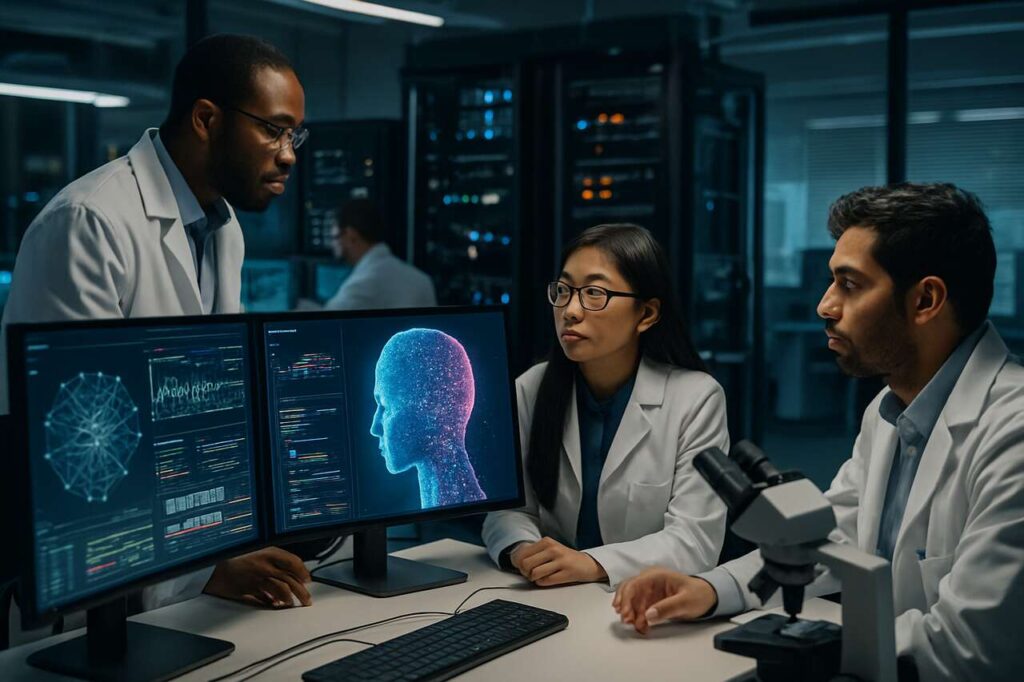
Artificial intelligence has long been associated with logic, computation and pattern recognition rather than the elusive quality of human creativity. Yet a recent study involving over 100,000 participants has challenged conventional assumptions about the boundaries between machine-generated and human-originated creative thought. Researchers set out to measure whether generative AI systems could match or even exceed human performance on standardised creativity assessments, producing findings that have significant implications for creative industries worldwide.
Context of the study on AI creativity
Origins and methodology of the research
The study, conducted by researchers at the Université de Montréal, represents the largest comparative analysis of AI and human creativity to date. Published in early 2026, the research employed the Divergent Association Task (DAT), a validated psychometric instrument designed to measure semantic distance in creative thinking. This task requires participants to generate words that are as unrelated to one another as possible, thereby testing the ability to make novel conceptual connections.
The scale of the study was unprecedented, with participation from:
- Over 100,000 human volunteers from diverse demographic backgrounds
- Multiple iterations of generative AI models, including GPT-4 and Claude
- Controlled testing conditions to ensure comparability across all participants
- Statistical analysis accounting for variations in creative ability across the human population
Why creativity measurement matters
Creativity remains one of the most difficult cognitive functions to define and quantify. Unlike tasks involving calculation or memory retrieval, creative thinking encompasses divergent thought processes, originality and the capacity to synthesise disparate concepts into meaningful wholes. The DAT offers a standardised approach to measuring one specific dimension of creativity, making it particularly suitable for large-scale comparative studies.
Understanding how AI performs on such assessments has become increasingly urgent as these systems are deployed across sectors traditionally dominated by human creative expertise. The findings provide essential context for ongoing debates about the role of artificial intelligence in fields ranging from advertising to architectural design.
Comparison: AI versus human creativity
Performance across the creative spectrum
The research revealed a nuanced picture of relative capabilities between artificial and human intelligence. When comparing AI systems against the full distribution of human participants, the advanced models demonstrated performance that exceeded the median human score on the Divergent Association Task. This finding suggests that contemporary AI has achieved a level of creative output that surpasses what an average person might produce under similar conditions.
| Performance Category | Human Participants | AI Systems (GPT-4) |
|---|---|---|
| Average creativity score | Baseline (50th percentile) | Above median performance |
| Top decile performance | Consistently superior | Below top human creators |
| Task completion consistency | Variable across individuals | Highly consistent |
The persistent human advantage
Despite AI’s ability to outperform average human creativity, the most imaginative individuals retained a clear advantage. Participants in the top 10% of creative ability consistently generated responses that demonstrated greater originality, conceptual depth and semantic distance than any AI system tested. This distinction highlights an important reality: while AI can achieve competent creative performance across standardised tasks, the highest expressions of human creativity remain beyond current technological capabilities.
The gap between AI and elite human creators becomes even more pronounced in domains requiring emotional intelligence, cultural understanding or narrative complexity. These findings set the stage for examining specific instances where AI succeeds and where it encounters fundamental limitations.
Test results: can AI surpass the average human ?
Quantitative findings from the study
The data collected from the massive participant pool provided statistically robust evidence regarding AI’s creative capabilities. When measured against the entire spectrum of human performance, generative AI models achieved scores that placed them comfortably above the 50th percentile. In practical terms, this means that AI systems can now produce creative outputs that exceed what half of all human participants generated under identical testing conditions.
Key statistical observations included:
- GPT-4 consistently scored in the 60th to 70th percentile range compared to human participants
- Performance varied slightly depending on the specific prompt structure and task parameters
- AI systems showed remarkably low variance in their outputs, unlike the wide distribution observed in human responses
- Repeat testing of AI models produced highly consistent results, suggesting algorithmic reliability
Interpreting the average threshold
The ability to surpass average human performance represents a significant milestone in AI development, yet it requires careful interpretation. The “average human” encompasses an enormous range of individuals with varying levels of creative training, cultural exposure and cognitive styles. AI’s success in this comparison does not necessarily indicate superiority across all creative contexts, but rather demonstrates competence in the specific type of divergent thinking measured by the DAT.
Furthermore, the consistency of AI performance raises interesting questions about the nature of creativity itself. Whilst human creativity often involves unpredictability and occasional flashes of brilliance interspersed with more mundane output, AI systems maintain a steady level of competence without the peaks and valleys characteristic of human performance.
These results naturally lead to questions about where AI excels in creative tasks and where it encounters inherent limitations that prevent it from matching the most accomplished human creators.
Examples of success and limitations of creative AI
Domains where AI demonstrates creative competence
Generative AI systems have shown remarkable capabilities in several creative applications. In the realm of ideation and brainstorming, these systems can rapidly produce diverse concepts that meet specified criteria. Marketing professionals increasingly utilise AI to generate campaign concepts, whilst product designers employ these tools to explore alternative design possibilities that might not immediately occur to human teams.
Specific areas of AI creative success include:
- Generating variations on existing themes or concepts with novel combinations
- Producing large quantities of creative options for subsequent human curation
- Creating content that adheres to specific stylistic or format requirements
- Synthesising information from diverse sources into coherent creative outputs
Where AI creativity encounters boundaries
Despite these successes, AI systems face significant limitations when creative tasks demand deeper qualities. In storytelling, for instance, AI-generated narratives often lack the emotional resonance and thematic coherence that characterise works by accomplished human authors. The systems struggle with maintaining consistent character development, creating meaningful metaphors rooted in lived experience, and imbuing creative works with authentic emotional depth.
Poetry represents another domain where human superiority remains evident. Whilst AI can produce technically correct verse with appropriate metre and rhyme schemes, the resulting poems frequently lack the layered meanings, cultural references and personal insight that distinguish memorable poetry from mere wordplay. The most creative humans bring contextual understanding, emotional intelligence and intentionality that current AI architectures cannot replicate.
Understanding these successes and limitations has profound implications for professionals whose livelihoods depend on creative work.
Implications for the future of creative professions
Economic significance of creative industries
The creative economy represents a substantial portion of global economic activity. In the United States alone, creative industries accounted for approximately 4% of GDP, translating to roughly $1.2 trillion in economic value. Globally, an estimated 500 million jobs are connected to creative sectors, spanning digital media, performing arts, design, advertising and numerous other fields where human creativity has traditionally been indispensable.
Job displacement concerns and realistic assessment
The study’s findings suggest a differentiated impact on creative professions. Roles that primarily involve routine creative tasks or the generation of standard content may face increased automation pressure. AI systems can efficiently produce competent work that meets average standards, potentially reducing demand for entry-level creative positions or tasks requiring moderate creative ability.
However, positions demanding the highest levels of creative excellence appear relatively secure. The persistent gap between AI and top-tier human creators suggests that roles requiring:
- Strategic creative direction and conceptual leadership
- Emotionally resonant storytelling and narrative development
- Cultural insight and contextual understanding
- Original artistic vision and distinctive creative voice
will continue to require human expertise for the foreseeable future. Rather than wholesale replacement, the more likely scenario involves a reconfiguration of creative work, with AI handling certain components whilst humans focus on higher-order creative challenges.
This evolving landscape points towards a future where the relationship between human and artificial creativity becomes increasingly collaborative rather than competitive.
The future of creativity: complementarity between AI and humans
Collaborative models emerging in creative work
Rather than viewing AI as a replacement for human creativity, forward-thinking organisations are exploring models of collaboration that leverage the strengths of both. AI excels at generating numerous options rapidly, identifying patterns across large datasets and maintaining consistency across repetitive creative tasks. Humans bring critical judgement, emotional intelligence, cultural sensitivity and the capacity to recognise truly exceptional ideas amidst numerous alternatives.
Emerging collaborative approaches include:
- Using AI for initial ideation phases with human refinement and selection
- Employing AI to handle routine creative tasks, freeing humans for strategic work
- Combining AI-generated components with human-created elements in hybrid works
- Utilising AI as a creative assistant that responds to human direction and feedback
Preserving human creativity’s unique value
The study’s findings reinforce the irreplaceable nature of elite human creativity. As AI systems become more capable of producing competent creative work, the distinction between adequate and exceptional becomes increasingly important. The most creative individuals possess qualities that extend beyond pattern recognition or semantic association: they draw upon personal experience, cultural knowledge, emotional depth and intentional artistic vision.
Educational systems and professional development programmes may need to emphasise these distinctly human creative capabilities, preparing individuals to work in environments where AI handles routine creative tasks whilst humans focus on innovation, strategic direction and the creation of work with profound cultural or emotional significance.
The research ultimately suggests that the future of creativity lies not in competition between human and artificial intelligence, but in thoughtful integration that respects the unique contributions each can make to the creative process.
The study comparing AI creativity against 100,000 human participants has illuminated both the impressive capabilities of current generative systems and the enduring superiority of the most creative individuals. Whilst AI can now exceed average human performance on standardised creativity assessments, elite human creators maintain a clear advantage in tasks requiring emotional depth, cultural insight and original vision. For creative professionals, these findings suggest a future characterised by collaboration rather than displacement, where AI augments human creativity rather than replacing it entirely. As these technologies continue to evolve, understanding the complementary strengths of artificial and human intelligence will prove essential for navigating the changing landscape of creative work.